A robot can turn a face in a camera image into points, movements, and a likely emotion label. The hard part starts after that: the same smile can mean happiness, politeness, tension, or nothing clear at all.
Quick read
- Cameras find facial landmarks such as the eyes, mouth, nose, and jaw.
- Software compares changes across several frames instead of reading one still image.
- Lighting, face coverings, culture, and personal habits can change the result.
What the robot sees
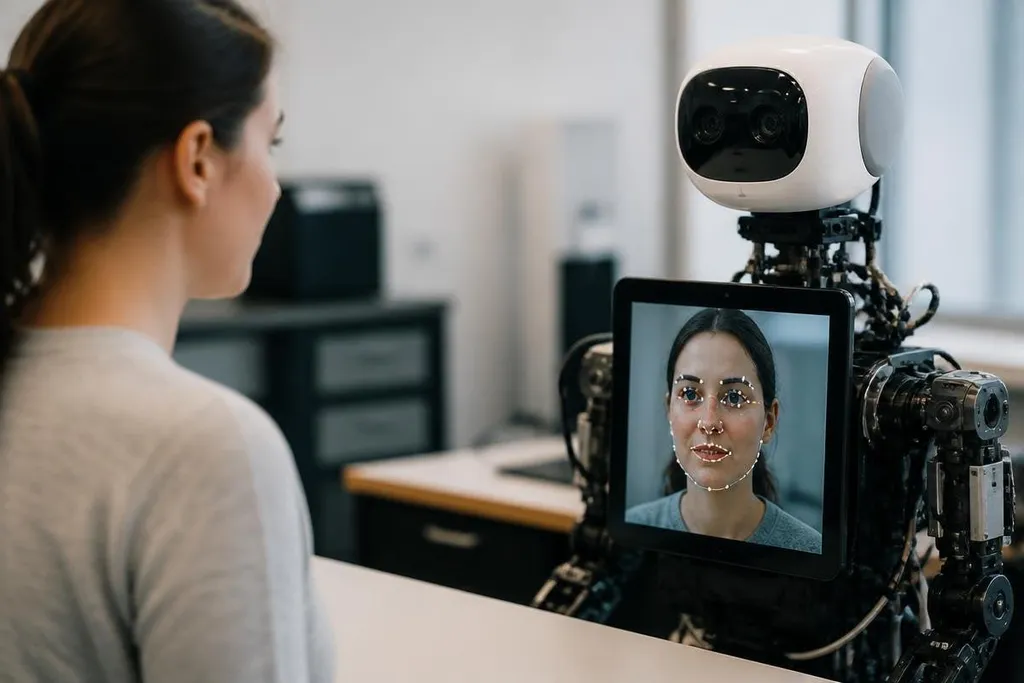
The robot starts with an image from an RGB camera, an infrared camera, or a depth sensor. Software then looks for facial landmarks, which are points that mark features such as the corners of the mouth and the edges of the eyes.
Those points give the system a rough face shape. The distance between the mouth corners can change. The eyebrows can rise. The head can turn or tilt. A depth sensor can add information about the face’s position in 3D, which helps when the person sits at an angle.
The robot does not see an emotion in the way a person does. It measures visible changes and sends them to a trained model. That model returns labels such as “smile,” “frown,” “surprise,” or “uncertain,” often with a confidence score.
A confidence score is a number that tells the robot how closely the image matches patterns in its training data. It measures a match to past examples, not the person’s private feelings.
Why movement matters
One frame can mislead the system. A person may open their mouth while speaking, blink during a pause, or raise one eyebrow as a habit. The software gets a better signal by checking a sequence of frames over time.
This process is called temporal analysis. The robot tracks how a face changes from one moment to the next, then compares the speed, direction, and size of those movements with examples in its model.
A smile that grows over several frames may receive a different label from a mouth shape that appears for one frame. The timing helps, though it doesn't settle the meaning. People can copy an expression, hide one, or show several feelings at once.
As facial-expression analysis moves from research demos into service robots, cameras, and workplace systems, robotics reporting on facial analysis can help you check which claims have a working system behind them.
Where the reading breaks down
The camera needs a usable view of the face. Strong backlight can remove detail. A mask hides the mouth. Glasses can cover the eyes, while a turned head changes the shape that the model expects to see.
Training data also affects the result. A model built from limited faces, lighting conditions, or expression styles may work well on similar images and perform worse elsewhere. That creates a technical problem and a fairness problem at the same time.
Culture and context add another limit. A wide smile may signal friendliness in one setting and discomfort in another. A quiet face may mean focus, tiredness, fear, or a person who does not show much emotion outwardly.
The safest systems treat expression labels as hints for the next action. A care robot might ask the person to repeat a request after detecting confusion. A reception robot might turn toward someone who appears to be speaking. The software should leave room for a direct reply instead of making a serious decision from a face alone.
A practical check before deployment
Before putting facial-expression software near customers, patients, or staff, check these points:
- Test the camera view: include low light, backlight, side views, glasses, masks, and different distances.
- Check the labels: write down which actions the robot takes after each label appears.
- Measure false readings: record cases where the system reports an expression that a person did not show.
- Give people another route: add speech, buttons, or a human review when the face reading is uncertain.
- Set a data limit: decide what images the system stores, for how long, and who can access them.
- Review the model: test results across age groups, skin tones, face shapes, and expression styles before use.
I’d treat an emotion label as a prompt for a question, never as proof of what someone feels.
The useful measure is what the robot does next. If it asks for confirmation when its confidence is low and records fewer false readings after each test cycle, facial analysis may help with a narrow task. The open question is how many systems will keep that limit once a face becomes an easy source of data.